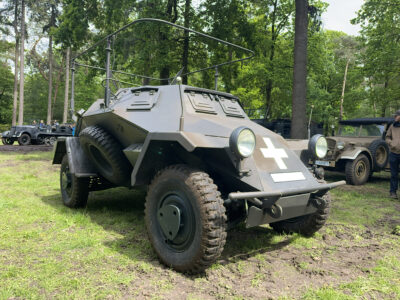
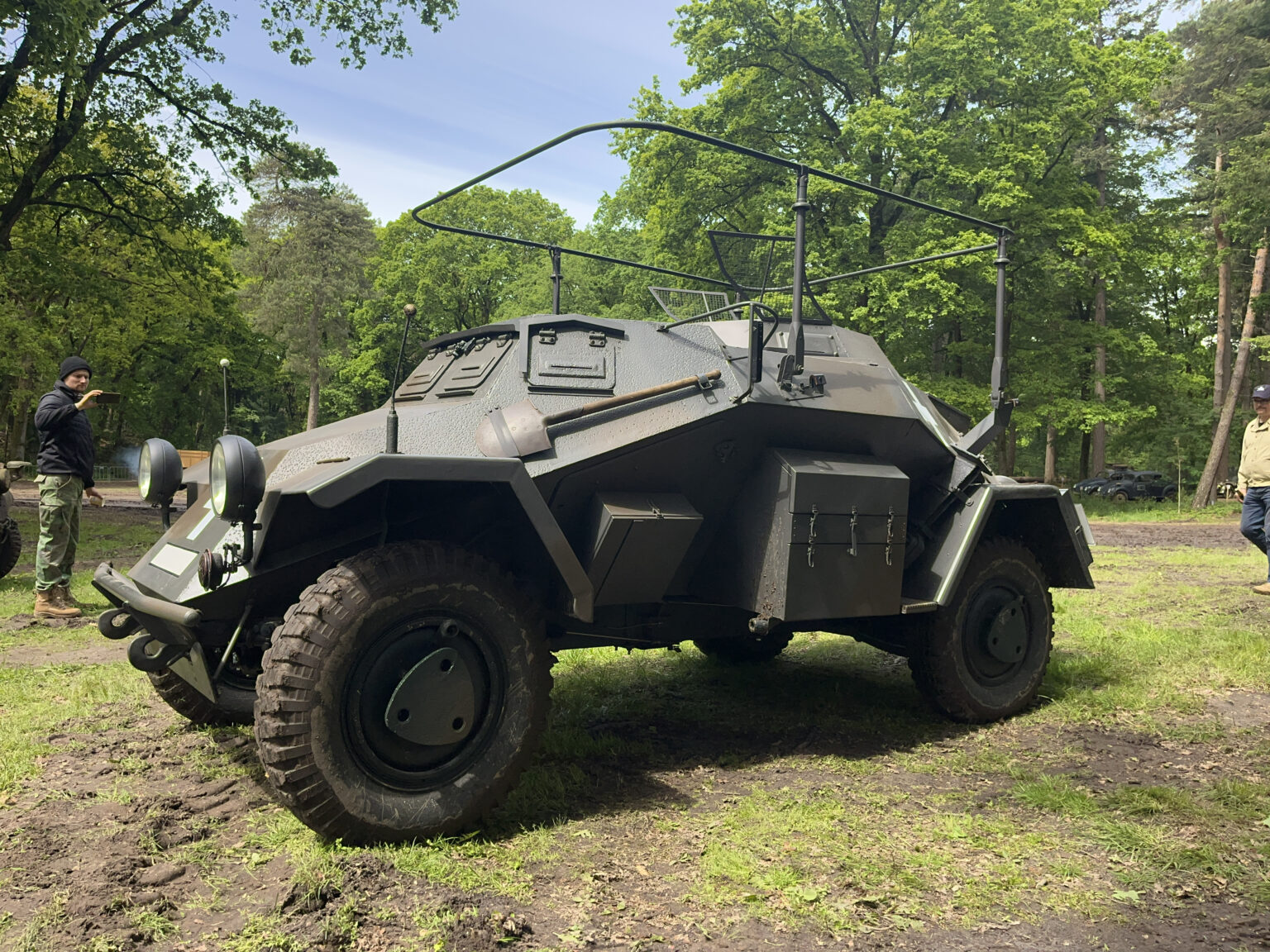
The Sd.Kfz.223 was developed as the radio and command variant of the leichter Panzerspähwagen family, pairing mobility and protection with long-range communications. Externally almost identical to the Sd.Kfz.222 armoured car, the 223 carried a single 7.92 mm MG 34 in a Drehsockel mount but was distinguished by its large folding frame aerial. Operated by a crew of three, it enabled reconnaissance patrols and armoured car platoons to maintain constant radio contact with higher headquarters. This made the 223 a crucial link in the German Army's fast-moving reconnaissance tactics, ensuring that frontline observations could be relayed quickly and accurately back to commanders.
Between 1936 and early 1944, only around 550 Sd.Kfz.223 were built, compared with nearly 990 Sd.Kfz.222. Its comparatively limited production, combined with its specialised role, makes the Sd.Kfz.223 one of the rarer armoured cars of the period.
About Our Sd.Kfz.223
Chassis 810740 was built at Auto Union's Horch A.G. works in Zwickau in May 1939 as part of the 3.Serie, and the completed vehicle was finished at MNH Hannover in September 1939. It was powered by the Horch 3.5-litre V8 petrol engine. Vision inserts and hatches for the type were supplied by Gebr. Böhler & Co. of Austria.
Provenance: Sizun and the German Withdrawal
Our Sd.Kfz.223 was discovered after the war outside La Poste in Sizun, Brittany, where the crew had disabled it with demolition charges in the engine bay during the German withdrawal towards Brest in August 1944.
Sizun lay on a German withdrawal route through Brittany identified in plans dating from early 1944. As Allied forces broke out of Normandy in late July, German units retreating towards Brest passed through the town. The deliberate destruction of the engine points to an organised immobilisation by a retreating crew rather than a hasty abandonment under fire.
An earlier hypothesis linked the vehicle to the Brasparts raid of 16 August 1944, but the connection no longer holds. German accounts describe the raiding column's armoured car firing a 2cm cannon, a weapon not carried by the Sd.Kfz.223. Fallschirmjäger unit records confirm no armoured cars were part of their establishment, and the raid's route along the Saint-Rivoal road bypassed Sizun town centre. The true origin of our Sd.Kfz.223 remains an open question, and one the Foundation continues to research.
Post-war use, reconstruction and acquisition
After the war a local in Brittany removed the armoured body and used the running chassis as a truck. The destroyed 3.5-litre engine was replaced with a 3.8-litre Horch V8. A Roscoff collector bought the chassis in the 1960s and later created a new body using a blend of original plates and new panels, guided by photographs and surviving fragments, and displayed the vehicle in his private museum. The Weald Foundation pursued the car for many years and eventually secured it by exchange.
Restoration and Completion
The Sd.Kfz.223 was restored in tandem with the Foundation's Sd.Kfz.222, which helped with specification cross-checks between two early Ausf. A vehicles. The restoration team chose to present the vehicle as it left the factory, not as a hypothesised 1944 standard. The factory specification is fully documentable, whereas the extent of in-service upgrades by 1944 is not. The restoration was completed in June 2024.
Fahrgestellnummer 810740 now represents one of the most complete and accurate restorations of an Sd.Kfz.223 Ausf. A. It links the development of German armoured reconnaissance before the war, the fighting in Brittany in 1944, and many years of careful research and conservation.