About the Jagdpanther
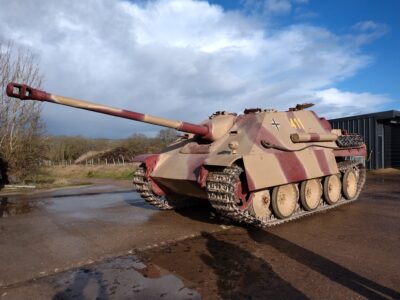
The Jagdpanther (Sd.Kfz.173) was developed to counter the growing threat posed by Soviet heavy armour on the Eastern Front, mounting the formidable 8.8 cm PaK 43/3 L/71 gun on the hull of the proven Panther medium tank. The result was one of the most capable armoured fighting vehicles of the Second World War: fast, well-protected, and renowned as a formidable long-range tank destroyer capable of engaging Allied armour at distances exceeding 3,000 metres. Only 413 Jagdpanthers were ever built, of which 112 were produced at MNH (Maschinenfabrik Niedersachsen-Hannover) in Hanover, including 12 assembled post-war under REME supervision, making surviving MNH examples exceptionally rare.
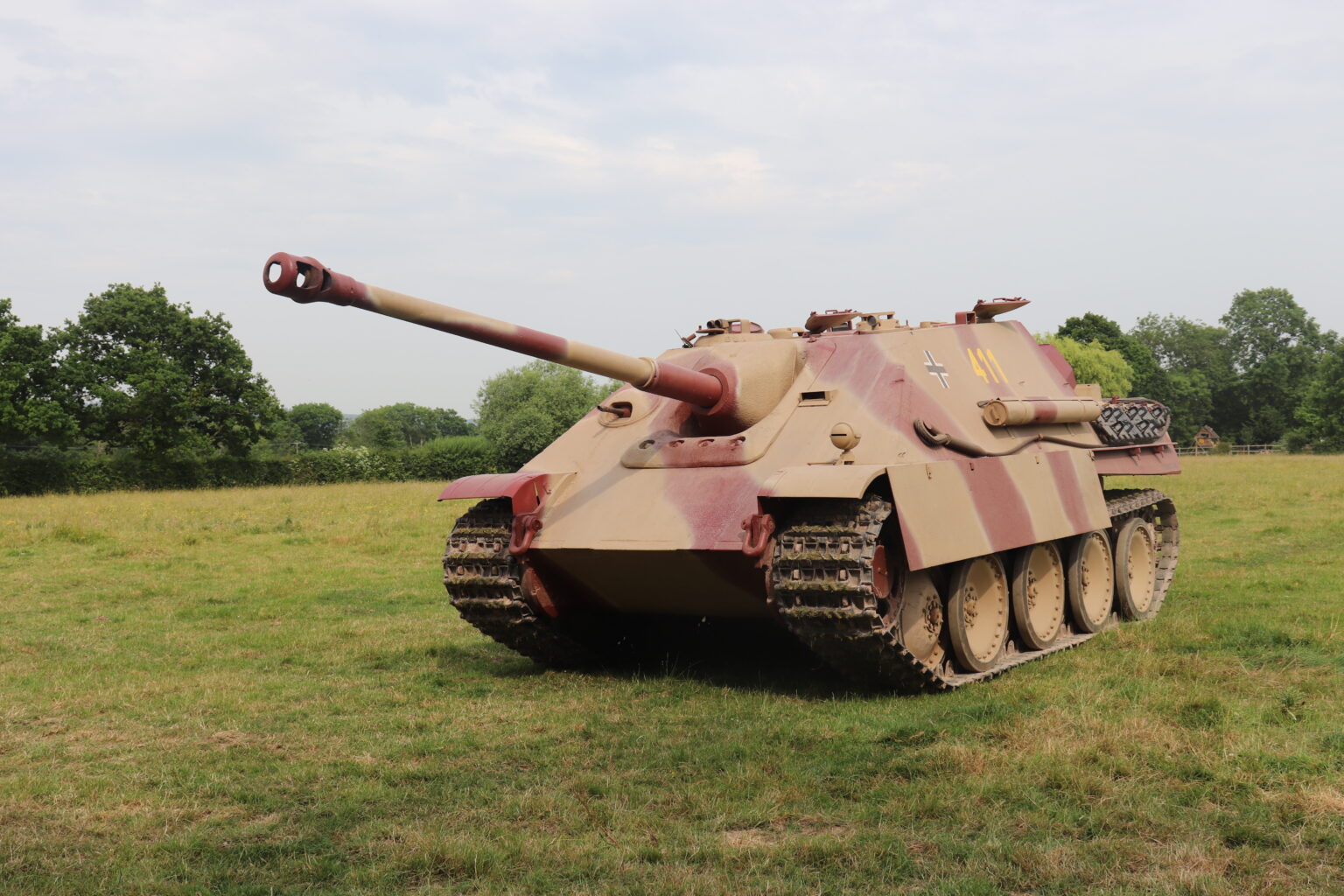
The Weald Foundation's Jagdpanther was manufactured at MNH in late February 1945 with Fahrgestellnummer 303086, and was among the very last of the wartime MNH Jagdpanthers manufactured. It is a late-production Sd.Kfz.173 Ausf. G2, among the distinguishing features of which are its larger bolted gun mantlet and two-piece 8.8 cm barrel, two of a number of significant differences from earlier production variants. Notable too is that on 27 February 1945, MNH informed the authorities that the supply of superstructure stowage bins was no longer available, making Jagdpanther 411 one of the last MNH vehicles to leave the factory with this stowage bin fitted, a small but historically significant distinction that was key to determining the Fahrgestellnummer.
Provenance
Manufactured between 24 and 26 February 1945, Fgst.Nr. 303086 was despatched to H.Z.A (Heereszeugampt) Sennelager to be kitted out in March 1945. It was then allocated and dispatched to the 116. Panzer-Division, the Windhund-Division, on 27 March and arrived near Recklinghausen, a town in the Ruhr region, on 30 March 1945. The vehicle was received by Panzer Regiment 16, the division's tank regiment of the 116. Panzer-Division. Days later, American forces completed the encirclement of the Ruhr industrial heartland. The division was trapped inside what became known as the 'Ruhr Pocket' and capitulated on 16 April 1945. The Panzer Regiment surrendered its remnants to the US 99th Infantry Division at a collection point near Iserlohn on that date.
How the vehicle came into British hands after the surrender is not yet known. It was subsequently brought to the United Kingdom in 1945 for evaluation by Colonel Gillman, a British Army range commander for Northern Europe, and it ended up at Pirbright ranges in Surrey. There it was used as a tug vehicle until an engine fire destroyed it beyond further use and was left as a range target. In the 1970s, Col. John Gillman, Colonel Gillman's son, recovered the vehicle from Pirbright so it could be restored. It then passed into private collector hands in Germany, where the Weald Foundation purchased it in 2000, alongside a second Jagdpanther, chassis 303110, one of the twelve post-war REME-assembled vehicles built at MNH.
Jagdpanther 411 is one of very few surviving examples whose wartime service can be documented through primary sources.
Restoration
The restoration spanned a decade. Large areas of the chassis walls required replacement. The engine, gearbox, gun mount, suspension, radio installation and intercom system all demanded either extensive remedial work or complete reconstruction.
The 8.8 cm Pak 43/3 L/71 was sourced from the West Wall Museum and the Maybach HL230 engine from the Overloon Museum in the Netherlands. Where original components could not be sourced, they were manufactured to period specification, guided throughout by primary documentary research and comparison with surviving examples worldwide.
The chassis number had been rendered unreadable by corrosion and shrapnel damage. Confirming it as 303086 required the combined efforts of Foundation Trustees and historians Hilary Doyle and Tom Jentz, and the forensic team from Kent Police's Forensic Unit, resolved through cross-referencing MNH records with the physical evidence on the vehicle itself.
Jagdpanther 411 is restored to its March 1945 configuration and is the only fully restored late-production Ausf. G2 held in a UK collection.