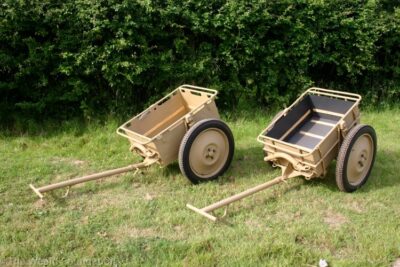
The Foundation’s collection reflects how vehicle technology evolved before and during conflicts around the world.
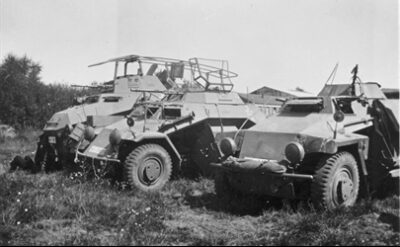
The Foundation began its collection with a range of German reconnaissance vehicles from the Second World War. The Foundation owns the Büssing-NAG eight-wheeled armoured car (Sd.Kfz.232), the lighter four-wheeled Sd.Kfz.223 Ausf.A (1939), Sd.Kfz.222 Ausf.A (1941) and Sd.Kfz.261 Ausf.B (1943), the light armoured half-tracks Sd.Kfz.250 Ausf.A (1943) and Sd.Kfz.250 Ausf.B (1944), and the medium armoured half-track Sd.Kfz.251 Ausf.D (1944).
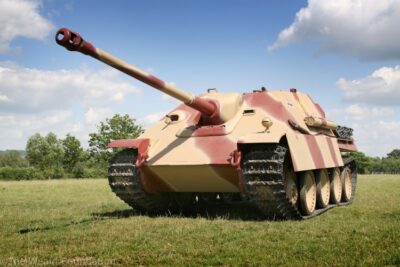
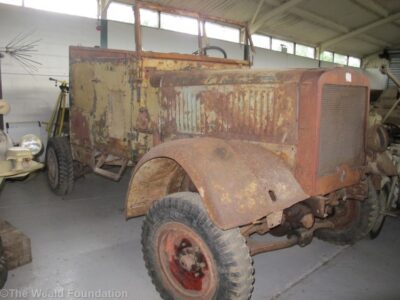
The Foundation’s heavy tracked vehicles include the Jagdpanther 411 (1945), armed with the 8,8cm gun, and the Sturmgeschütz, mainstay of German anti-tank defence from 1943. The collection also includes examples of the most important towed anti-tank guns, the 7,5cm Pak 40 and the formidable 8,8cm Pak 43, together with a range of light vehicles providing logistical support, including trucks, personnel carriers and motorcycles owned by the Foundation.
The German element of the Foundation’s collection is now complete. A defined restoration programme with set timelines is in place for the Foundation’s remaining German vehicles yet to be restored.
The attraction of restoring tanks from the First World War, together with the challenge of gathering exceedingly rare war machines from the former British Empire, led the Foundation to add two further branches to its collection: a First World War Collection and the Empire Collection. The Foundation has completed restoration of its Renault FT and Renault TSF, and has acquired an original Weitz Remorque Porte Char tank transporter trailer for these 1918 vehicles.
The Empire Collection reflects the Foundation’s intent to acquire vehicles missing from the National Collection that are considered unique or rare elsewhere in the world. The Foundation owns a rare Local Pattern Carrier Mk I (1940) from Australia, two Reconnaissance Cars (Marmon-Herrington) Mk III (1941 and 1942) from South Africa, the predominant armoured car of Allied forces during the period, and an Indian Pattern Carrier built in New Zealand.
The work never ends. The Foundation undertakes maintenance programmes on every vehicle in its collection, replaces components with better or more original examples where possible, and at some point in each vehicle’s life rebuilds engines and gearboxes completely. Appropriate storage of these vehicles, given the relative extremes of the local climate, remains a constant challenge.